
Walking Through the Arch
On Archfall and the Medium That Fits the Message

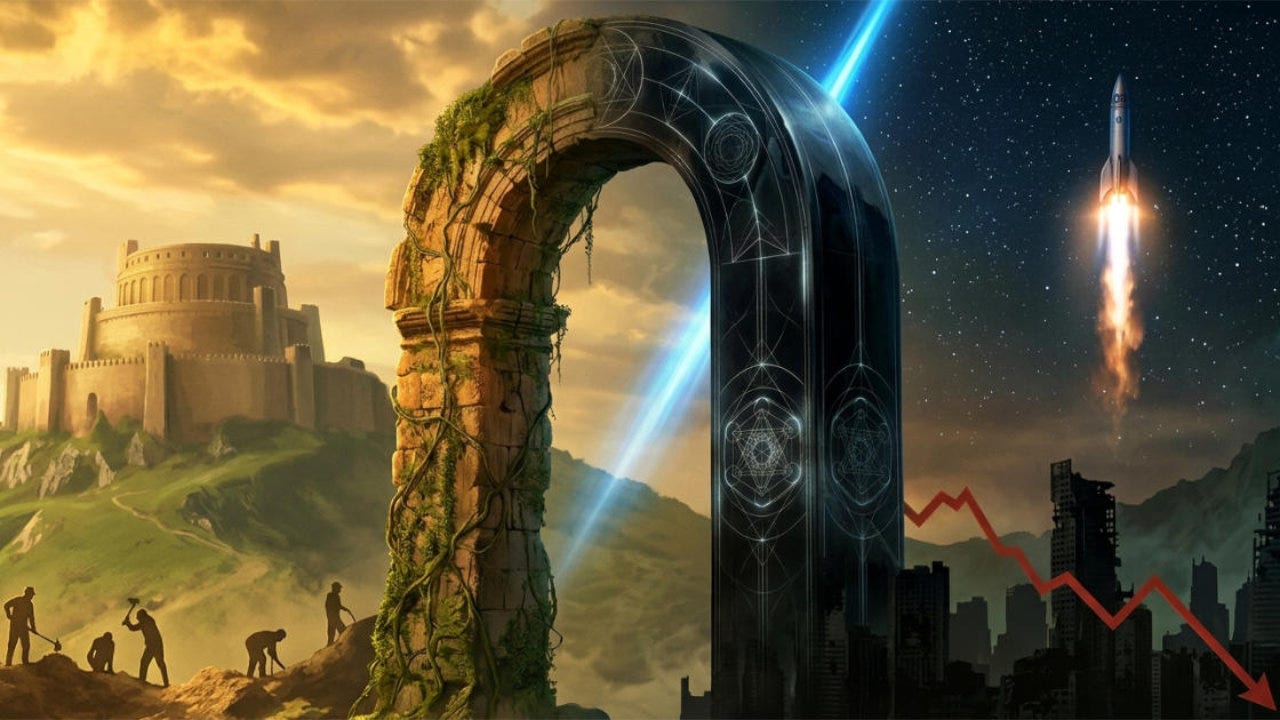
There is a question that every serious work eventually has to answer: what form does this idea require?
Not what form is available. Not what form is conventional. What form does the idea actually require, the form in which the argument is not described but inhabited, not explained but experienced from the inside?
I had been working on a trilogy, even though I didn’t know it when I started the first volume. That is what the full argument required. The three movements are distinct in register, in method, and in what they ask of the reader.
The Keystone is the affirmative book. It is about what the arch is, what it was for, and what it feels like to live under one that still bears weight. It is written in the register of someone who believes that the pattern is real and that the pattern is worth preserving.
The Fallen Arch is the diagnostic book. It is clinical rather than mournful. It maps the mechanism of collapse, the seven layers of a cascade that has no villains, only conditions, mechanisms, and people trying to live inside them.
Archfall is the inhabitation. It does not describe the arch or diagnose its failure. It drops you inside the cascade while it is still in motion and asks you to act.
The UI as Argument
From the first node of Archfall, the interface begins to do something that prose cannot do: it externalizes your understanding in real time.
In the upper left, seven stones form a semicircular arch. They begin dark. As the story locks in each layer of the cascade, the corresponding stone illuminates. Not as a reward. As a reckoning. Hover over any stone and a tooltip surfaces its meaning within the system. This is not a progress bar. It is the conceptual architecture of the work itself, made visible as you build it. No published work of interactive fiction does quite this: the diagram is the model the story was written from, and you watch it assemble as you move through the narrative.
Six hexagonal icons represent the six structurally distinct potential endings. They are visible from the beginning, not as spoilers, but as architecture. You can see the shape of what is possible before you know which of it you can reach.
Fourteen character portraits line the right edge of the screen in grayscale. Each one illuminates in color the moment you meet them. This is not a relationship meter. It is closer to a dramatis personae that fills in as your chosen story unfolds: a ledger of presence, not performance.
Five accumulating scores track the structural consequences of your choices in real time. These are not points. They are the load-bearing measurements of the civilization you are either shoring up or allowing to settle. By the end, the panel is a precise diagram of the self you brought to the cascade. The story is highly replayable, as you will make different choices based on your current self, and you will likely reach a different ending if you replay.
Two artifacts surface during the story. What they mean, and what they unlock, unfolds in the last third. I will say nothing more about them here. That is the point.
The characters, the arch stones, the endings, the plot arc: these are yours to discover. The inhabitation is the point. I am not going to hand you a map of the territory before you have walked it.
Why This Form, and Not the Others
I want to be precise about this, because it is not obvious.
The Keystone is in paperback only. Not because I could not have made it electronic or interactive, but because the argument requires the very thing it describes. The book’s central claim is that certain practices are worth preserving precisely because they are costly, slow, and irreducibly human: deep reading, hand-drawing geometry, raising the next generation. I call these sacred anachronisms. They are not inefficiencies to be optimized away. They are the load-bearing practices of a coherent human life, and they are load-bearing in part because they resist acceleration.
A paperback that asks you to sit still, hold a thread across 555 pages, and let a mind that is not yours restructure your own is not incidentally the right form for that argument. It is the argument, enacted. The medium is the anachronism.
The Fallen Arch is in paperback and Kindle (and now Audible audiobook). The argument is diagnostic. It asks you to follow evidence across 86 detailed endnotes, an extensive glossary and 5 appendices. The form should be searchable and marginalia-friendly. It is a book you might read in a comfortable chair or an ebook you might read on a train and annotate and argue with.
Archfall is browser-based and free. The argument is about what it feels like to stand inside the cascade and try to build something. That argument cannot be made in a form you observe from the outside. It has to be made in a form you move through. The choices have to be yours. The consequences have to accumulate in a panel you can see. The arch has to be one you are building, stone by stone, in your own mind. This cannot be done in a static book or ebook.
The interactive form is Archfall’s argument. This is not a metaphor.
How It Was Made
I want to say something about the making of this, because I think the making is part of the story.
Before I worked with AI, I authored 24 books in the traditional way: a word processor, my knowledge and imagination, and years of dedicated craftsmanship. My relationship with technology is not professional only. It is lifelong and deeply personal. I have spent more than five decades walking on artificial legs. That experience did not grant me an automatic advantage. The adaptation it required forged a relentless work ethic and a specific intuition for adapting to complex systems, an intuition I later used to master and teach some of the most complex design software on the planet to architects and engineers for 25 years.
When I began working with AI, I brought that same orientation. Not a casual dalliance with a single tool. A deep iterative dialogue with frontier language models, hands-on work with diffusion models for the art, specialized tools for research and translation. I am the composer. The AI is my orchestra. Every work is human-directed and human-edited for voice, coherence, and originality.
Archfall took hundreds of hours of that kind of work. I “vibe-coded” (aka coding without coding) its unique AI in many stages, building the branching logic, the variable tracking, the conditional endings, the cross-hub story flags that carry a choice made in the second hub into a consequence in the sixth. Sometimes I would sleep on a problem and wake with a new structural insight and vibe code it into the UI in the morning. The moral architecture of the choices, the weight of each branch, the way the five scores interact to determine which endings are reachable: all of this was built iteratively, tested, revised, rebuilt.
I believe I am pushing the boundaries of interactive fiction into a new space. Not in the direction of spectacle or scale or optimized monetization, but in the direction of literary density, moral seriousness, and formal integrity. The UI is not decoration. The branching is not gamification. The prose is patient and precise and refuses to dramatize what is already devastating.
A Note on Audio
Most story nodes feature an integrated audio player beneath the hero image. If you receive narrative better through the ear than the eye, you can have the story read to you by a realistic AI narrator as it unfolds. A small number of endgame nodes are too dynamic to support audio because their prose is conditionally rendered on the page, depending on the choices you made, but the vast majority of your journey through the cascade is voiced. Of the nodes that are offered in audio form, there is a total of 3 hours 14 minutes of content, a fortuitous numerical synchronicity with π. You can read or listen to Archfall the way you would listen to an audiobook, but triggered one choice at a time.
The Invitation
I have made Archfall free, no strings, no accounts, no email. There are no streaks, no notifications, no dopamine loops, no monetized engagement. In the lower corner of the screen there is a small link for those who want to support me, the author, which I do appreciate. It is not a toll. It is an invitation for those the story reaches to close the energetic circuit with its composer, a token gesture in the price of a coffee or tea, if the work has been load-bearing for them.
If it hasn’t, walk through the arch and take whatever you find with my gratitude.
The possibility of the Citadel doesn’t close. The path you didn’t take is still there. So is the version of you that might take it.
Read more about the project at sacredgeometryacademy.com/archfall
Walk through the arch at archfall.com